The 10x Employer
Only 39% of respondents in McKinsey’s 2025 survey reported any enterprise-level EBIT impact from AI. About 6% qualified as high performers. High performers were nearly three times as likely to redesign workflows and more likely to define when human validation was required. McKinsey, 2025
The seat count is visible. The operating conditions are not. A license can make one task faster while prompting, checking, coordination, security review, exceptions, and rework keep total capacity flat.
Ten times what?
In a preregistered experiment with 758 BCG consultants doing timeboxed, simulated consulting work, GPT-4 users completed 12.2% more tasks, worked 25.1% faster, and produced higher-quality results on suitable tasks. On one task outside the tested capability frontier, AI users were 19 percentage points less likely to reach the correct answer. Dell’Acqua et al.
That is useful evidence about a bounded setting. It is not a 10x employer. The multiplier remains an ambition: more accepted business value without an equivalent rise in human hours. Count accepted outcomes, then include the work around them.
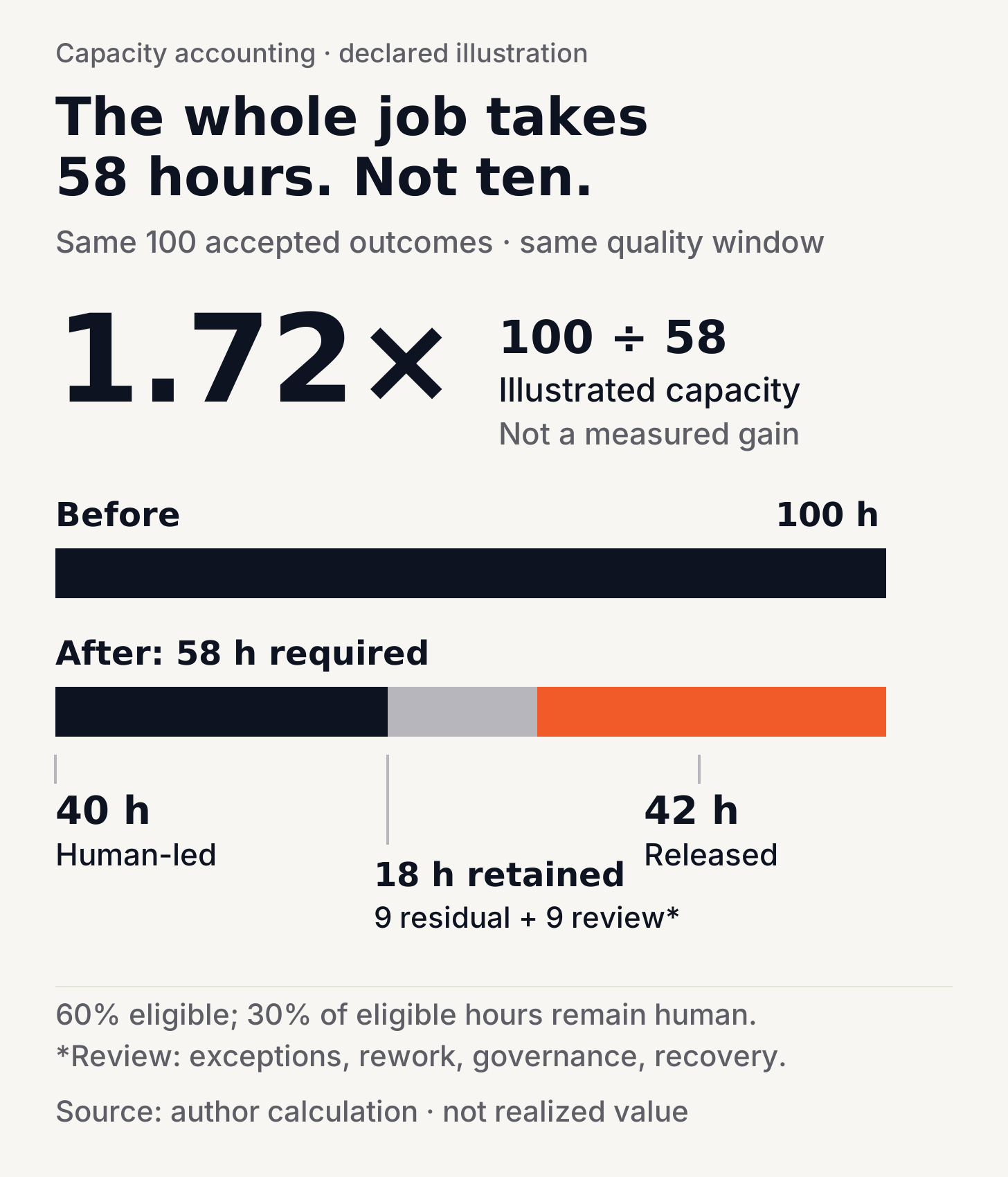
Consider a declared hypothetical. A team spends 100 human hours producing 100 accepted outcomes. Hold those outcomes and the downstream quality window constant. Assume sixty hours are eligible for delegation and 30% of those hours remain recurring human burden, or 18 hours. The new total is 40 human-led hours plus 18 hours of residual work, review, exceptions, governance, and recovery: 58 hours. The illustrative ratio is 100 divided by 58, about 1.72x. The 60% and 30% inputs are assumptions, not measured deployment results. Released time is not yet realized value.
Follow one workflow
Consider a proposed renewal workflow using approved account records and a shared mailbox. The owner authorizes those sources and may refuse observation or supply a manual example. Personal messages stay excluded. The first runs produce drafts only. Read access does not grant permission to change the account record or send a message.
The reviewer checks terms against sources and confirms the approving person. A conflicting renewal date stops the packet and preserves both the conflict and the draft. After correction, the owner reruns the checks. Acceptance requires accurate terms, permitted sources, and authorization through the declared quality window. A fast draft that builds a larger review queue has deferred the work.
In a P&G product-development experiment, AI-assisted individuals matched the rated performance of unaided two-person teams. Separately, the HBS research account reports that AI-assisted individuals spent 16.4% less time than the control group. That is a time comparison in the experiment, separate from the quality comparison. Harvard Business School
Authority can expand only after evidence. Recommendation, drafting, confirmed execution, and bounded autonomous action are different permissions. A model’s confidence is not authority. The workflow needs a named reviewer, a way to narrow or revoke access, and a record of the last good state.
Evaluate the actions behind an AI result
A correct answer is only part of a good AI workflow. Define what an assistant may do, what evidence it keeps, and how you recover when it goes wrong.
The Anatomy of a 10x Employee
High impact is accepted work plus a more capable next cycle, not message volume or rescues. What the research says about experts, managers, and handoffs.
A Privacy Toggle Is Not a Firewall
A training toggle answers one question. Safe AI use needs four boundaries: training, transmission, retention, and tool authority. Test the action.
Before calling AI resistance sabotage, test the rollout
A survey says 29% of employees sabotage AI rollouts. Treat it as a reason to investigate: find the failure, protect reporting, then repair and retest.