The Anatomy of a 10x Employee

High impact is accepted work plus a more capable next cycle, not message volume or rescues. What the research says about experts, managers, and handoffs.
Table of Contents
Meet your new assistant.

One assistant, every channel, the work handled. Create an account in seconds.

High impact is accepted work plus a more capable next cycle. It is not message volume, meeting count, or the number of emergencies one person absorbs before lunch.

Expertise must land somewhere

In a cross-sectional study of 69 software-development teams, expertise coordination was strongly related to team performance after accounting for team inputs, the presence of expertise, and administrative coordination. Coordination meant knowing where expertise lives, recognizing where it is needed, and bringing it to the problem. This association does not establish a causal formula for performance. Faraj and Sproull

A longitudinal study of 64 MBA consulting teams found that stronger transactive memory systems, meaning specialization plus credible knowledge of who knows what, were associated with higher performance and viability in that setting. The lesson is not that one expert should answer every question. It is that expertise needs a map and a transfer path. Lewis
The Collaboration Tax 2026, a Paciva research report

The expert and the manager do different work

Weidmann and coauthors ran a preregistered laboratory experiment with 555 participants. A one-standard-deviation increase in measured managerial skill corresponded to a 0.22-standard-deviation increase in team performance after accounting for production skill. Separately, teams whose manager was selected by strongest expressed preference to lead performed 0.10 standard deviations below teams with randomly assigned managers. Those are separate estimates from a purpose-built lab task. The paper calls that preference-based selection “self-promotion”; it is not a study of corporate promotions. Weidmann et al.

An excellent contributor may locate the hard problem, resolve an exception, and make the reasoning retrievable. A manager has to allocate work, set sequence, protect attention, invite unwelcome information, and build a team that can operate without one answer queue. Promotion is not proof of either aptitude.
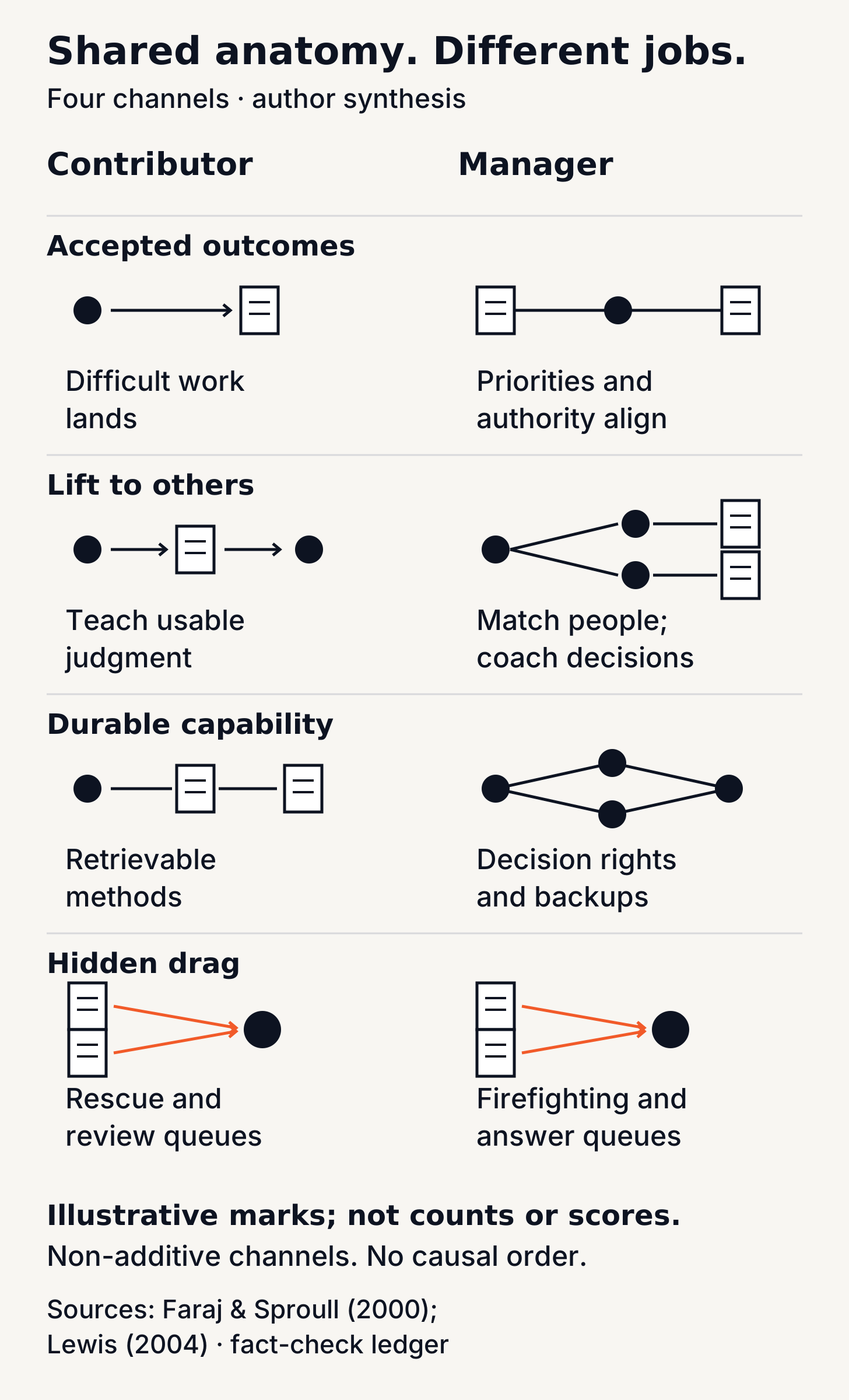
Proposed diagnostic comparing contributors and managers across accepted outcomes, help to other people, durable capability, and hidden drag. It is not an employee rating tool.

Rescue can become a system defect

Imagine two versions of a launch blocked by a duplicate import. In both, the same specialist repairs the test import and delivers the same accepted launch. One team retains only the fix. The other budgets paid transfer time and authorizes a backup to handle an identical test retry after checking the source and expected record count. A changed source, count mismatch, or production-data change still stops and escalates.

At recurrence, the first team calls the specialist again. The second can resolve the defined routine case during the specialist’s absence. The specialist remains necessary for novel cases. Urgent, rare, regulated, or nontransferable work can correctly require direct intervention; a one-off task does not require a permanent manual.

Treat the example as a diagnostic hypothesis, not a replacement test. Ask four questions:

  1. Who owns the primary decision?
  2. What help is bounded enough to preserve the helper’s primary work?
  3. What gets recorded so the next person can retrieve the reasoning?
  4. What happens when the expert is unavailable?

The absence test should expose missing transfer and authority, not invite an employer to remove the expert. Recurrence can mean a stable operating contribution, an underfunded support function, or a hidden single point of failure.

Focus is part of the anatomy. Perlow’s nine-month study of a software-engineering team found that interaction was necessary while constant interruption fragmented individual work. Leroy’s experiments found that unfinished work followed participants into the next task and reduced performance there. Neither study supplies a universal meeting quota or context-switching percentage. Perlow Leroy

The practical measure is the after-state: accepted result, visible reasoning, clean handoff, and a next cycle that needs less rescue. The individual contributes judgment. The organization supplies the conditions that let judgment transfer without turning every capable person into an interruption queue.

Read the full essay on Substack →

Publisher: Paciva. This is an operating framework, not a claim that a particular product passes every test.

Put Pax to work

An executive assistant that carries the working memory of your professional life and finishes the work across the tools you already use.

Oct 13, 2026

Evaluate the actions behind an AI result

A correct answer is only part of a good AI workflow. Define what an assistant may do, what evidence it keeps, and how you recover when it goes wrong.

Sep 29, 2026

The 10x Employer

Only 39% of firms in McKinsey's 2025 survey saw any EBIT impact from AI. Count review, rework, and recovery before you call it a 10x gain.

Sep 22, 2026

A Privacy Toggle Is Not a Firewall

A training toggle answers one question. Safe AI use needs four boundaries: training, transmission, retention, and tool authority. Test the action.

Transform how your organization operates with Paciva

Transform how your organization operates with Paciva

Product updates, how-tos, community spotlights, and more. Delivered monthly to your inbox.