
Test an AI agent against the business job it must do
Before adding another AI agent to a business workflow, define the result it should improve and the correction work it should reduce. A necessary function does not automatically need another agent. Searching, checking, authorizing and recording can be implemented with different combinations of models, people and application logic. Their contributions need different tests.
An answer-quality score can reward a busy reviewer while overlooking a permission check. Removing the latter because it did not improve the prose would confuse the job with the measurement.
I would start with a claim the workflow must preserve, then compare functioning ways to preserve it.
Follow the missing condition
Consider a hypothetical report comparing three suppliers’ export arrangements. Each searcher retains the passages supporting its findings. One document says basic export is available, but audit-history export requires another plan.
The integrating agent reduces this to “Export available.” A buyer needing audit history could now select an unsuitable plan. The sentence is tidy; the decision is worse.
A reviewer that opens the source can restore the missing condition. A reviewer reading only the summary cannot establish that the qualification survived. Agreement with the report is not source verification.
The original agent might perform that check before finishing. A person might inspect the material claims. A separate review stage is another option. The function is necessary for this assignment; its implementation remains a choice.
Match evidence to purpose
The source review should catch consequential omissions without creating excessive correction work. The search stage should find relevant sources and answer the requested questions. Execution records should connect the original passage, shortened claim and correction so a later failure can be located.
Authorization follows its own path. This report may be ready for internal reading while an external send remains unauthorized. Application logic can enforce that boundary. It does not need a higher prose score to justify doing so.
Preserve the required boundary while comparing enforcement implementations separately. The same principle applies to traceability: a usable record matters more than the number of calls producing it.
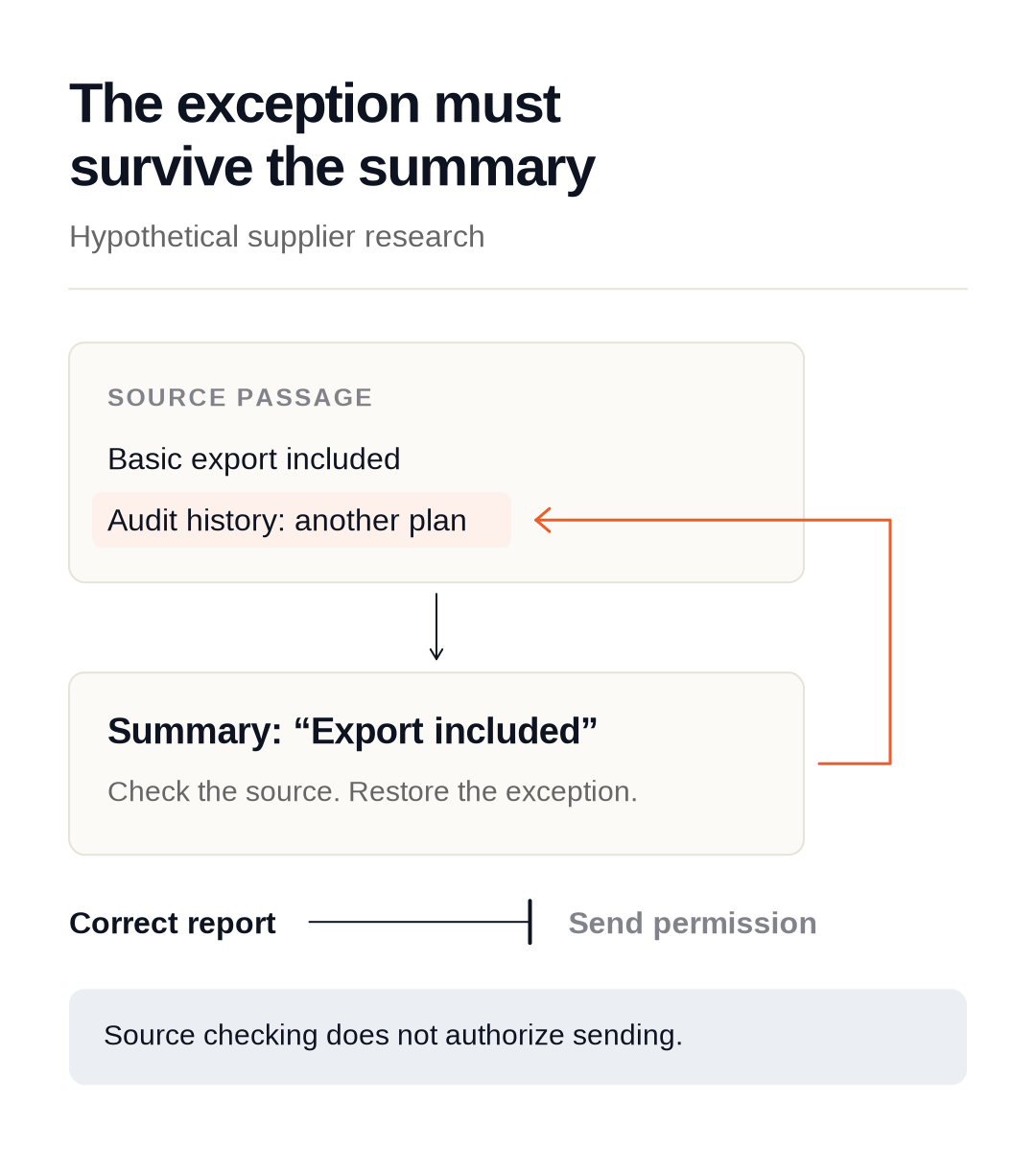
Hypothetical supplier report. Preserve necessary functions while comparing implementations.
Fill the acceptance record
For the proposed source-review stage, I would use this record before running a comparison:
| Field | Supplier-report acceptance case |
|---|---|
| Job | Detect a material export condition lost during integration. |
| Evidence | Catch the audit-history exception; count misses, false alarms and repair time across the task set. |
| Cost | Execution spending, delay and human investigation. |
| Consequence | A buyer could choose a plan lacking the required export. |
| Decision | Retain an effective stage, repair missing source access, or remove an optional stage that adds burden without useful contribution. |
This is an evaluation proposal, not a reported result. Include correct claims that should pass and missing information that should remain a gap. Independently check the reference cases rather than asking the reviewer to establish its own accuracy.
Compare capable alternatives. When testing a new stage, add it to a baseline that already has the tools and information needed. When testing removal, make sure the remaining arrangement still functions. Parallel searchers without an integration path are not a fair alternative to a complete report writer.
If workers and an integrator contribute together, test the combination. For a purchased reviewer, compare the product with current review practice rather than pretending to dismantle its inaccessible internal stages.
Separate the bills
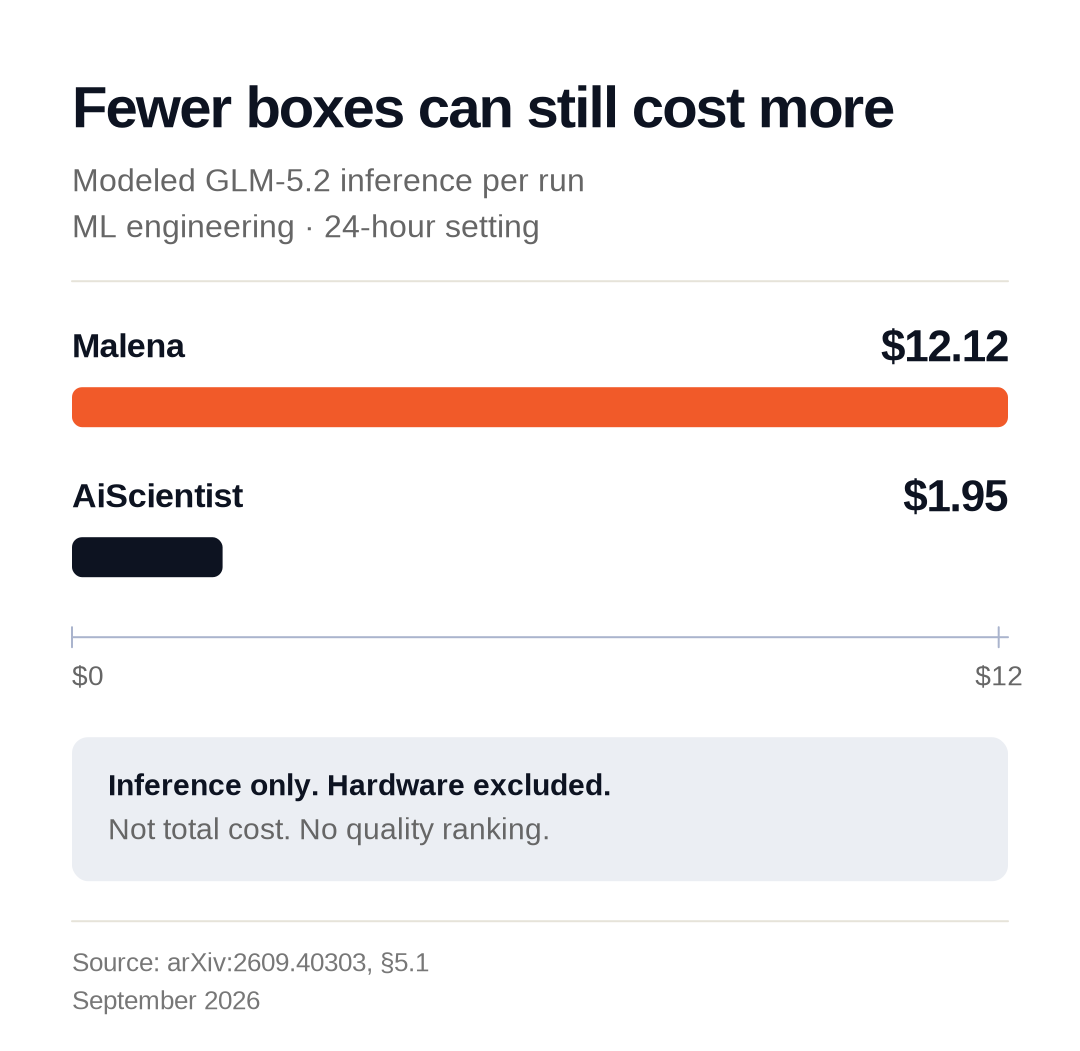
$12.12 and $1.95 were modeled inference costs per run for the tool-using agent Malena and the multi-stage system AiScientist in one GLM-5.2 setting in an ML-engineering preprint. Hardware is excluded. (Preprint, section 5.1)
Those amounts do not rank total value. A useful comparison includes completed quality, elapsed time, execution spending and human repair. Fewer components alone cannot answer the cost question.
Choose the constraint first. Under a deadline, compare quality and spending. Under a spending ceiling, compare quality and elapsed time. Report the remaining quantities without quietly changing the question after seeing the result.
Evaluation itself has a cost. Begin with representative work and effort proportionate to the decision. A cheap reversible addition may need a modest trial; a consequential boundary needs deliberate failure tests. A small sample with no unauthorized actions cannot certify rare-event safety.
New in Pax Contacts: See Who Is Waiting on You
Pax Contacts now shows who is waiting on you, who is going cold and what you owe them, so you can track professional relationships without a spreadsheet.
Do Big Tech and Frontier AI Labs Owe America More Than Profit?
Big tech responsibility in the age of AI goes beyond profit. Should the firms that built our digital world help defend it from AI cyber attacks?
I Gave My AI Too Many Rules. It Stopped Doing Anything.
My AI social pipeline failed almost every post because I gave it too many rules. Here is how to write AI instructions that get real work done.
Choose an AI work skill by testing what the task needs
Before you book more AI training, test what the task needs. Some gaps need practice. Others need missing facts or a decision. A returns queue shows how.
