
Choose an AI work skill by testing what the task needs
Choose AI training by identifying what prevents correct, usable work in a task that matters to the business. A fast draft can still be attached to the wrong order; practice should address the cause before accelerating the output.
Consider a hypothetical support-operations specialist with ten hours to practice. Their task turns a returns-ticket export into a checked next-action queue and unsent replies. No refunds are issued.
Each ticket must connect to the right order, the next action must follow the supplied policy, missing facts must be flagged and replies must promise no unsupported outcome. Ten hours is a planning budget, not a measured threshold.
Inspect one mixed queue
Some tickets are matched correctly and need repetitive formatting. Other records were associated by customer name despite duplicate names. One lacks an order ID. A correctly matched damaged-item request has been treated under the ordinary change-of-mind rule, although the policy supplies an exception.
Timing alone will not diagnose that queue. Check the associations and proposed actions against the four conditions. A saved view could remove repetitive work while accelerating the incorrect cases.
Separate what practice can repair from what it cannot supply. An absent ID requires information. An unresolved policy question requires its owner’s decision. Neither becomes a training deficit because the worker encounters it.
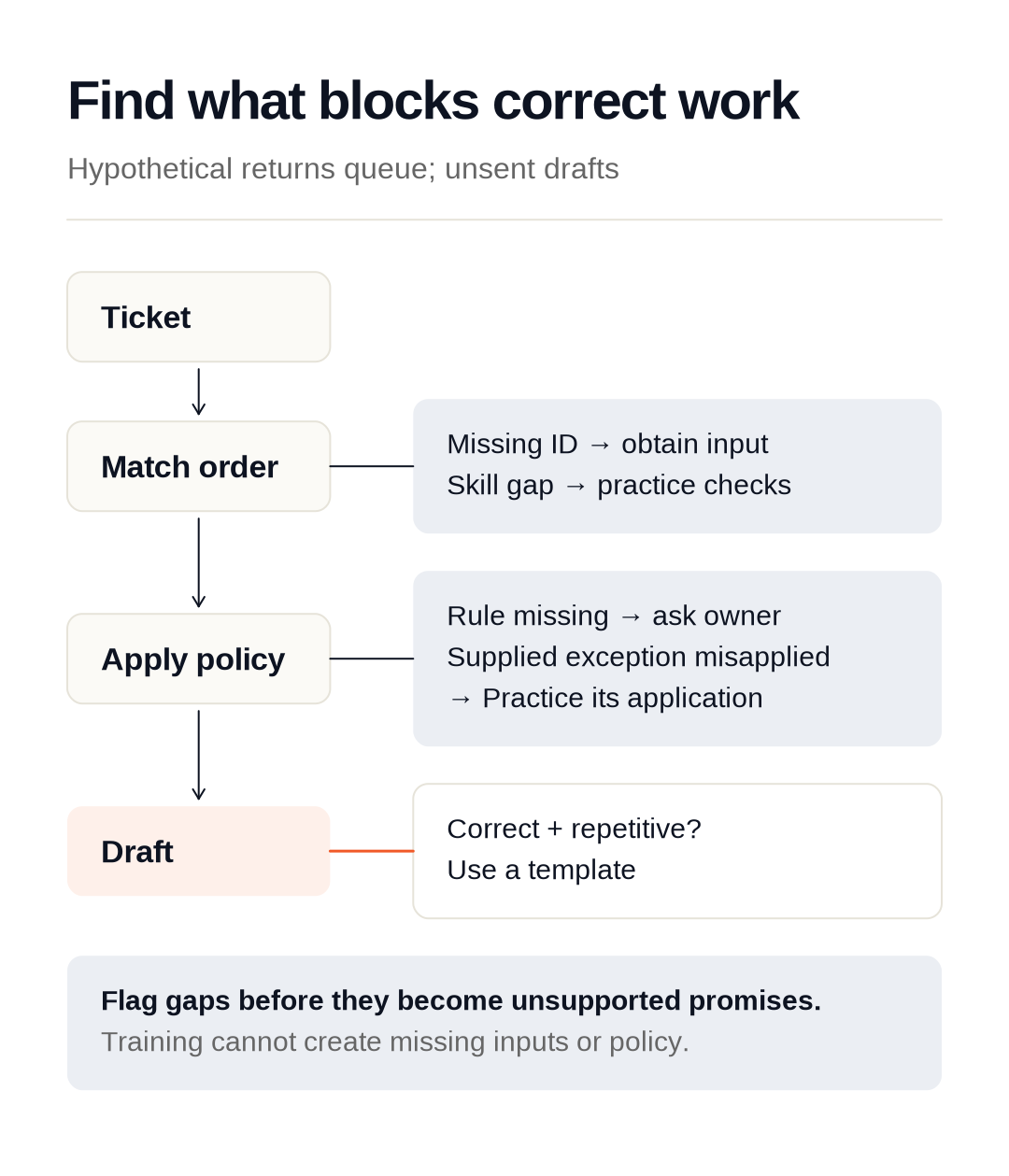
Some obstacles need practice; others need facts or a decision.
Practice where understanding is missing
For name-based mismatches, practice tracing the ticket to a unique order identifier. Include duplicate names, missing IDs and valid matches. Explain which associations are supported, then inspect the tool’s actual output.
AI can propose a formula or mapping. The worker needs a way to verify that it fits these records and to recognize a match the available information cannot establish. Memorizing every command is not the same requirement.
For the damaged-item case, use the supplied policy and an agreed answer key. Explain the next action and the fact changing it. Alter a fact and inspect whether the answer should change.
If the policy does not resolve the case, stop that practice branch and obtain clarification. More repetition cannot create the missing rule.
Speed up the reliable subset
The correctly matched, policy-correct tickets can use a saved view and draft template. Arrange the required fields, separate unanswered questions from established facts and keep the proposed action visible.
Inspect the first drafts before applying the template more broadly. Count setup, checking and later repair alongside repetitive work removed. A temporary shortcut may still earn that effort if the task recurs.
Stop customizing when the relevant task is handled acceptably. The remaining learning budget need not be spent completing every feature in the tutorial.
Make the next check fit the purpose
Use fresh fictional cases in the relevant tool and record what help is available. Check correct associations, policy application, missing facts and unsupported promises again.
Reliable assisted completion can be the workplace goal. Independent explanation and application in another tool are additional observations, not automatic consequences of using assistance successfully.
If portability matters, keep the task, policy and field meanings fixed while trying fresh comparable cases in another application. Record aids and interface difficulties. The exercise may show what needs relearning; it does not establish a skill’s half-life or isolate a causal learning effect.
If portability is irrelevant, stay with fresh cases in the tool the work requires.
New in Pax Contacts: See Who Is Waiting on You
Pax Contacts now shows who is waiting on you, who is going cold and what you owe them, so you can track professional relationships without a spreadsheet.
Do Big Tech and Frontier AI Labs Owe America More Than Profit?
Big tech responsibility in the age of AI goes beyond profit. Should the firms that built our digital world help defend it from AI cyber attacks?
I Gave My AI Too Many Rules. It Stopped Doing Anything.
My AI social pipeline failed almost every post because I gave it too many rules. Here is how to write AI instructions that get real work done.
The Week in AI: Nov 7 to Nov 13, 2026
Nvidia names Colette Kress interim CEO after Huang resigns, trump suggests Tim Cook for Nvidia CEO role, and more of the AI news from Nov 7 to Nov 13.