
Evaluate AI service value and provider risk separately
An AI service can help a business without proving that its provider is profitable or able to repay its loans.
Consider the claim: “The customer gains $40 each month, so the supplier can comfortably repay its loan.”
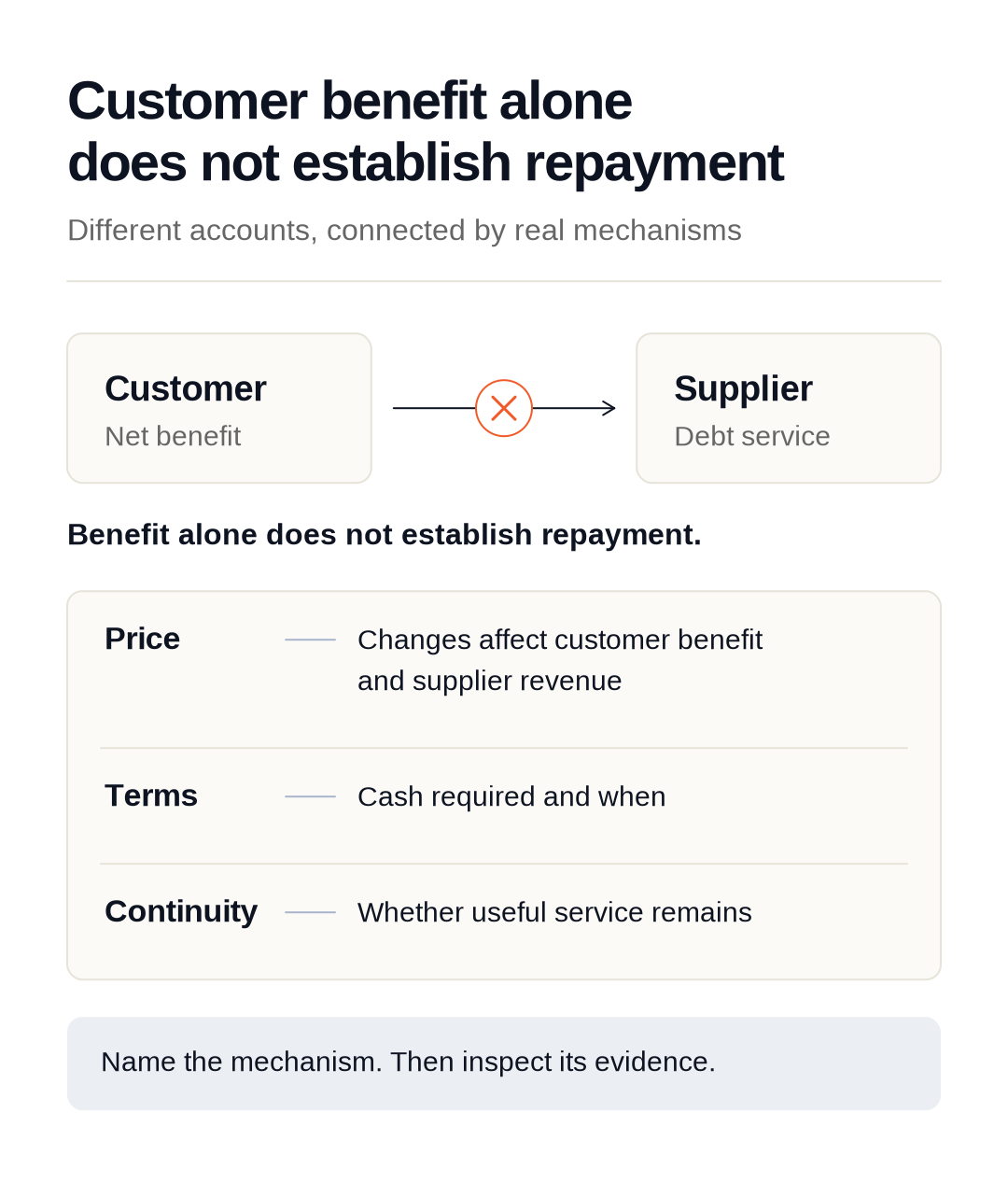
That hypothetical claim changes accounts halfway through. Customer benefit is not cash the supplier receives. A workflow result needs another connection before it can establish a financing conclusion.
The distinction does not make supplier economics irrelevant to adoption. Price, terms, and continuity can connect those accounts. A useful audit shows both the unsupported inference and the connection worth investigating.
Start with the customer’s result
Assume a monthly report is worth $150 to the customer, which pays $100 for it and incurs $10 in handling inputs and checking the output. Net benefit is $40. The valuation is stipulated, not a measured cash saving.
The application receives $100. If its exhaustive operating costs are $60 for model services and $20 for other expenses, it earns $20 operating profit before financing and taxes.
The customer’s $40 is not another payment to that business. Adding it to supplier cash would count a transfer that never occurred.
The same care applies downstream. If the model provider pays infrastructure from its receipts, those transactions do not become additive customer value. Each supplier’s profit requires its own costs.
Identify the connection
Raise the application’s other operating expenses to $50 while holding its $60 model bill fixed. Operating costs become $110, and the loss is $10. The customer still receives the same report at the same price and retains $40 of benefit.
Supplier economics have changed without changing current usefulness. They could nevertheless motivate different prices, terms, or support decisions. A buyer can examine that exposure before an explicit withdrawal notice exists.
Hold customer value and handling cost fixed. Benefit is $140 minus subscription price: $40 at $100, $10 at $130, zero at $140. Those figures establish room within the assumption, not a customer’s actual willingness to accept an increase.
At a $110 price and unchanged $110 operating costs, the application would break even operationally, and the customer would retain $30. This does not cover financing obligations or establish a sustainable vendor price.
Test the repayment claim
Return to the original $20 operating-profit case at a $100 price, separately from that operating break-even example.
Assume operating receipts and expenses are cash this month, with no capital spending, working-capital change, or tax payment. Fix interest expense and interest paid at $5. There are no spare cash reserves and no new financing.
The company then has $15 profit before tax and $15 cash available before principal repayment. If $10 principal is due, $5 remains. If $30 is due instead, the funding shortfall is $15. Operating profit stays $20, and profit before tax stays $15 because all expenses remain fixed.
Principal repayment returns borrowed money; it is not an operating expense. In a real refinancing, interest, fees, and other terms might change too. The simplified example keeps them the same to isolate the cash requirement.
The customer still gains $40 in both schedules. Its benefit therefore cannot prove that the supplier can meet the larger payment. Actual reserves, financing, or changed terms might address the shortfall, but they require evidence.
New in Pax Contacts: See Who Is Waiting on You
Pax Contacts now shows who is waiting on you, who is going cold and what you owe them, so you can track professional relationships without a spreadsheet.
Do Big Tech and Frontier AI Labs Owe America More Than Profit?
Big tech responsibility in the age of AI goes beyond profit. Should the firms that built our digital world help defend it from AI cyber attacks?
I Gave My AI Too Many Rules. It Stopped Doing Anything.
My AI social pipeline failed almost every post because I gave it too many rules. Here is how to write AI instructions that get real work done.
Choose an AI work skill by testing what the task needs
Before you book more AI training, test what the task needs. Some gaps need practice. Others need missing facts or a decision. A returns queue shows how.
