
Define the business rule before delegating a task to AI
Before an AI-generated list directs business work, check that its selection rule matches the task’s purpose. Two lists can contain the same number of customers and assign work to different people.
Consider a hypothetical request for “active customers.” Sales uses current contract status. Finance uses an invoice paid within the past 90 days. Both definitions serve legitimate purposes, but the shared instruction has not selected one.
Compare membership before totals
Four invented accounts expose the distinction:
| Account | Current contract | Invoice paid within 90 days |
|---|---|---|
| Aster | Yes | Yes |
| Birch | Yes | No |
| Cedar | No | Yes |
| Dune | No | No |
Current contract selects Aster and Birch. Recent payment selects Aster and Cedar. Both totals are two. Aster is shared, while Birch and Cedar make the decision visible.
An agent might choose payment recency and report only the count. That is a possible interpretation in this example, not universal model behavior. The request can execute successfully while its purpose remains unsettled.
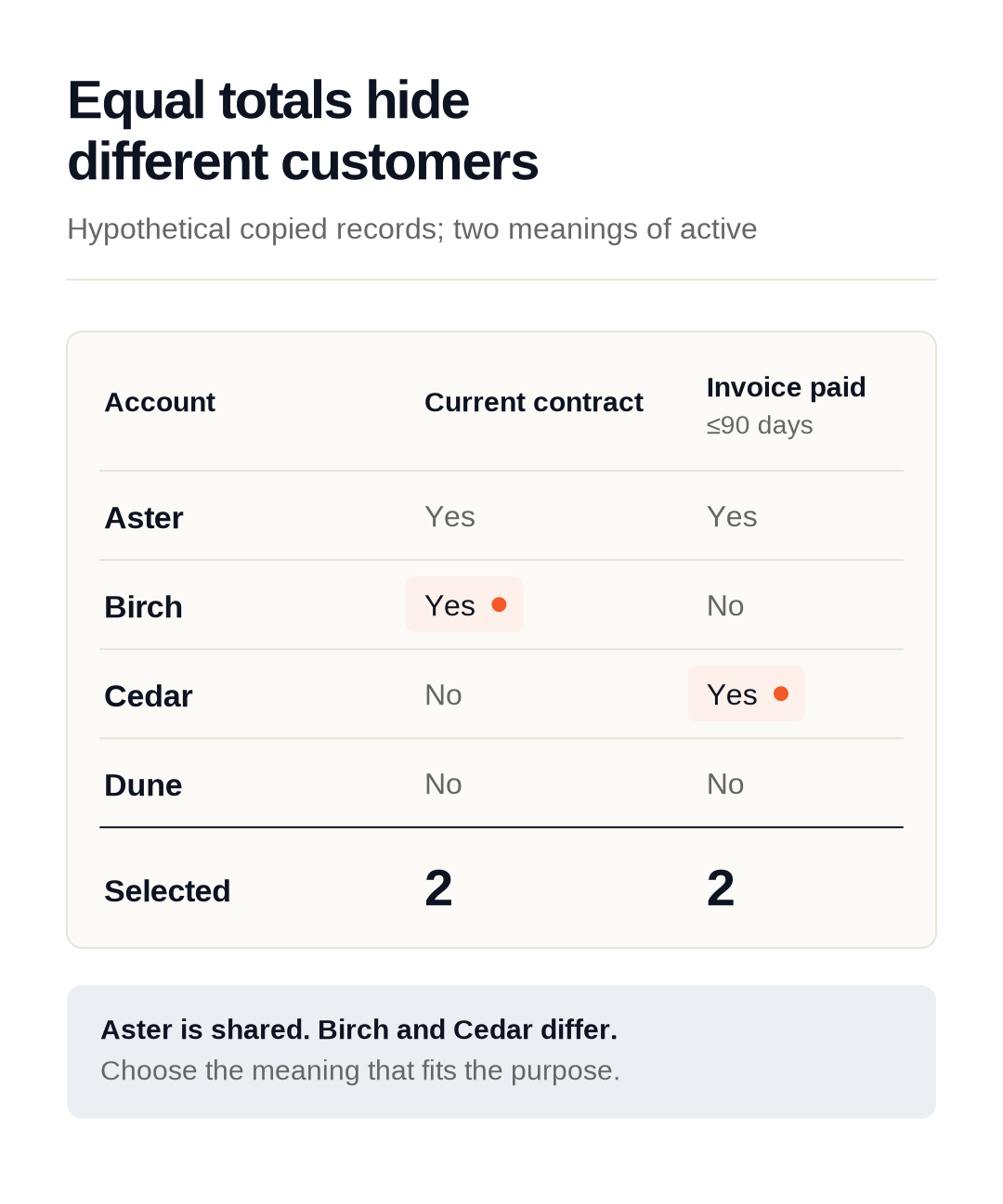
The sample exposes a choice; it does not validate a production rule.
Ask before constructing the sample
“Current-contract service planning or recent-payment reporting?” may resolve the choice directly. If the task already has a governing definition, use it rather than reopening it.
If the owner remains unsure what the difference means, show both lists on copied, inert records. No downstream work follows yet. Ask which accounts need the intended work and why.
For current-contract service planning, Aster and Birch belong. Finance can retain its recent-payment measure under a distinct label. Neither department needs to be universally wrong.
Sampling supports clarification here. It does not replace the person responsible for deciding the purpose.
Make disagreement observable
Aster and Dune alone would be a poor sample. Both definitions include Aster and exclude Dune. A successful run would conceal the cases on which the rules diverge.
The four rows cover every combination of the two stipulated yes-or-no conditions. They do not validate a rule against actual customer complexity. Neither candidate definition may fit the real task.
Unknown contract status also falls outside those yes-or-no rows. Inspect the underlying record or mark the status unknown. Do not classify it as no because the selected definition needs an answer.
These are different problems. Purpose chooses the meaning; investigation supplies a missing fact. A longer prompt does not eliminate either decision.
Follow the roster into preparation
Suppose the list feeds weekly service reviews and staff begin preparing account notes. If the task requires current contracts but the workflow selected recent payment, Birch is omitted and Cedar included.
A summary saying “two active customers” can conceal that mismatch. The first visible difference may arrive after people have acted. A corrected roster cannot recover preparation time already spent.
An ordinary query could encode the same mistake. AI does not invent ambiguous business terms. An agent accepting ordinary-language instructions can make the unresolved interpretation part of execution, which is the concern here.
Compare this with the inert sample. The same records reveal the difference before work begins. Exposure depends on what uses the result and when someone inspects it, not merely whether the file can be edited.
New in Pax Contacts: See Who Is Waiting on You
Pax Contacts now shows who is waiting on you, who is going cold and what you owe them, so you can track professional relationships without a spreadsheet.
Do Big Tech and Frontier AI Labs Owe America More Than Profit?
Big tech responsibility in the age of AI goes beyond profit. Should the firms that built our digital world help defend it from AI cyber attacks?
I Gave My AI Too Many Rules. It Stopped Doing Anything.
My AI social pipeline failed almost every post because I gave it too many rules. Here is how to write AI instructions that get real work done.
Choose an AI work skill by testing what the task needs
Before you book more AI training, test what the task needs. Some gaps need practice. Others need missing facts or a decision. A returns queue shows how.