
Test the business handoff before adopting AI-built software
A business considering software built with AI should test the full job before replacing its current tool. A correct-looking image does not settle whether the candidate can carry a design workflow. Another person may need to revise it tomorrow. That person’s next step belongs in the purchase.
Start with one recurring job. Replacing an entire suite is a different decision, and a smaller substitution can be useful if its handoff works.
Separate the deliverables
Consider a hypothetical team producing campaign images and event cards. A campaign contains an editable headline and a product photograph with a mask, which controls the visible portion of the image.
The designer must change the date and move the photograph, then deliver a finished image and a master another designer can revise. A final PNG can look correct while lacking the editable headline and mask the recipient needs.
Export the final image and save the master separately. Close and reopen the master. Have the intended recipient make the next date change in the agreed environment. Check appearance as well as editability.
Keep the original and use a representative copy. Record versions and the recipient’s tool before interpreting the result. An untested handoff remains untested, even when the export looks persuasive.
Include the recipient’s constraint
The recipient’s existing environment may effectively determine the format. Standardization can save repeated conversion work. A candidate that handles an individual operation well may still introduce more work across the team.
An agreed exchange arrangement that preserves the required edits may solve that problem. Its inspection and maintenance belong in the comparison. If it cannot carry the required edits, retain this workflow while considering another job.
Do not require unused suite features to survive. Do require the parts somebody actually needs. That lets the challenger compete without quietly weakening the assignment.
Price the same future period
For this team, compare the next quarter’s recurring work under both arrangements.
Moving includes remaining build or configuration effort, conversion, inspection and training, followed by applicable operating charges and maintenance. Staying includes licensing, repeated manual steps and limitations the alternative might remove. Separate one-time work from recurring work on both sides.
Include the split’s maintenance and recovery readiness needed this quarter. Examine a later exit separately rather than charging all of it to this period. Someone must preserve usable inputs, recover them if the utility is unavailable and explain the process to the next colleague. No invented failure probability is needed to identify those dependencies.
Build work already paid for and last year’s training bill are already spent. Acquired skills may reduce future effort, which does matter. A retained campaign license also remains payable when event cards move. Reduced manual work can be worthwhile without becoming canceled subscription spending.
Let the smaller replacement compete
The event card requires a finished PNG, not the layered campaign master. Its date could be changed by regenerating the card from saved text, an image and known settings.
A utility could remove repeated project-opening and export work. But let a colleague perform the next revision before crediting that benefit. They need access to the inputs and a working tool, not merely the previous PNG.
Assign an owner to the shared material and the boundary between tools. When branding changes, both workflows may need attention. Preserve the inputs so retiring the utility does not require rebuilding the work from finished images.
Move the card task if regeneration produces the accepted output and the work removed exceeds the operation and coordination introduced. If the creator must rescue each revision, improve the handoff or keep the current process.
The campaign can remain where its editable state survives. The event card can move where its next regeneration works. Neither outcome establishes that the whole suite has been replaced.
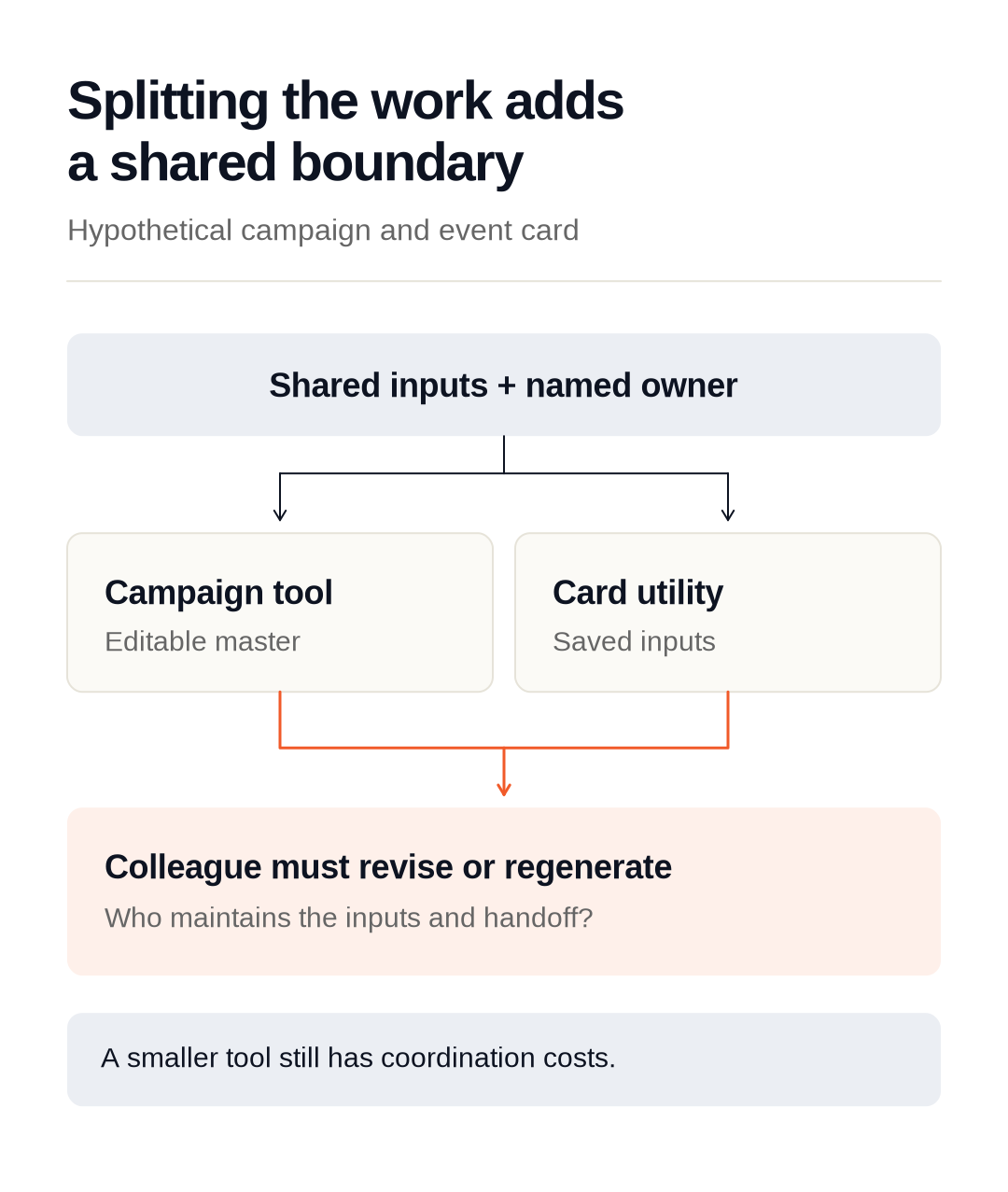
Test the colleague’s next revision on both paths.
New in Pax Contacts: See Who Is Waiting on You
Pax Contacts now shows who is waiting on you, who is going cold and what you owe them, so you can track professional relationships without a spreadsheet.
Do Big Tech and Frontier AI Labs Owe America More Than Profit?
Big tech responsibility in the age of AI goes beyond profit. Should the firms that built our digital world help defend it from AI cyber attacks?
I Gave My AI Too Many Rules. It Stopped Doing Anything.
My AI social pipeline failed almost every post because I gave it too many rules. Here is how to write AI instructions that get real work done.
Choose an AI work skill by testing what the task needs
Before you book more AI training, test what the task needs. Some gaps need practice. Others need missing facts or a decision. A returns queue shows how.
